Are You Selling the Right Foodservice Items?
McLane supports retailers on the journey to build and operate successful foodservice programs.
Oct 08, 2026 | 4 min read
This article is brought to you by McLane.
“Food is one of the most significant growth drivers for the future of c-stores,” said Farley Kaiser, vice president of retail foodservice at McLane. “Yet the reality is that foodservice is one of the most complex and operationally demanding parts of the business. Operators are balancing countless priorities every day, which is why solutions that simplify execution and delivery quality, and consistent products are so critical.”
Foodservice made up 28.0% of in-store sales in 2025 and contributed 38.3% of in-store gross profit, according to the NACS State of the Industry Report® of 2025 Data.
But retailers looking to heat up some of those sales and profits for their own stores could face challenges when building a food program.
One important task is figuring out exactly what should go on the menu. Do you start with sandwiches or bank on breakfast foods? Operators also have to figure out cooking equipment, food packaging, space constraints and a slew of logistics, from labor to food waste.
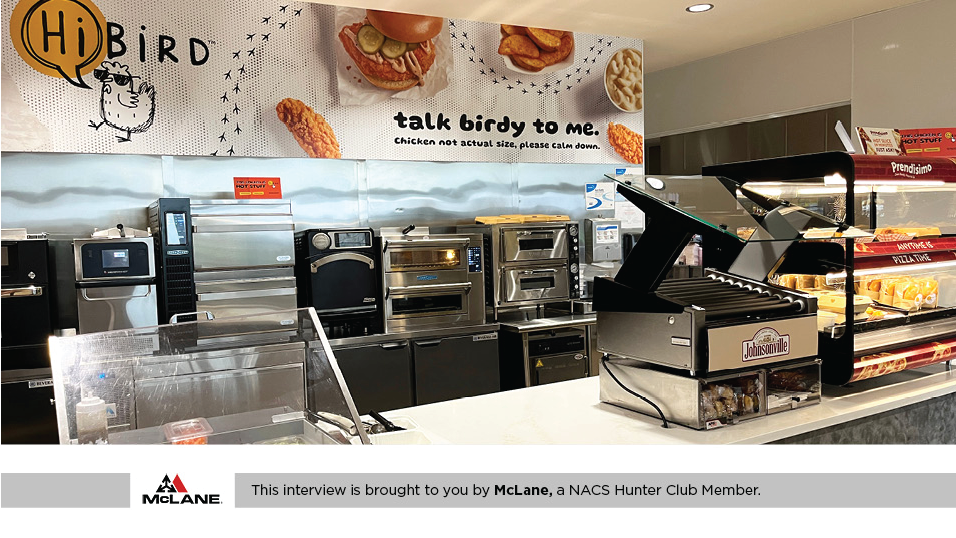
The Innovation Kitchen at McLane’s headquarters in Temple, Texas, provides a space for operators to get hands-on with equipment and products as they learn.
“McLane does more than distribute food and retail items,” Kaiser said. “We support retailers on the journey to build and operate successful foodservice programs.”
One of the biggest barriers that retailers face is labor constraints, according to Kaiser.
Foodservice can be a revenue driver for c-stores, but it requires employees who know how to work with food. In 2025, the average cost to hire a part-time associate was $1,057 and the average cost to train them was $1,038, according to the NACS State of the Industry Talent Insights Dashboard. With wages rising in recent years—2025 was the first year NACS recorded an average full-time hourly wage above $15—those expenses can add up.
Rather than cutting hours in the kitchen, McLane looks for ways to make the work more efficient, Kaiser said.
“We evaluate labor through the lens of automation, asking whether a machine can perform the task more consistently and efficiently. If anyone can push a button and achieve the same food-safe, high-quality result every time, that’s the direction we want to go,” Kaiser said.
Packaging can also play a role in helping with labor constraints, according to Anne Hughes, McLane’s director of retail foodservice.
She pointed to McLane’s Central Eats hot breakfast and lunch sandwiches, which arrive prepackaged and can be heated in their bags with either a microwave or rapid-cook oven. “It reduces a lot of the labor of hand-building the sandwich in the back of the house, but it also streamlines the handling of the product,” Hughes said.
Limited space is another challenge for retailers, according to Hughes.
“The majority of [convenience retailers] do not have cookie cutter operations,” said Jeremy Reinicke, corporate executive chef at McLane. Multilocation retailers have kitchens of different sizes and different configurations—and many operate in space-constrained environments.
He said that McLane’s Innovation Kitchen can be a place to open retailers’ eyes to what is possible. The full-scale replica of a convenience store allows retailers to test equipment and products in an immersive environment.
For example, retailers can see precisely what a 6-by-8-foot section dedicated to foodservice would look like, said Reinicke.
“You might have a worktop freezer with an oven on top, a packaging rack overhead and a prep station with a cutting board alongside the oven,” he said. “It shows operators how to maximize every inch of available space.”
Continue reading "A Recipe for Foodservice Growth" in the October 2026 issue of NACS Magazine.
