Preparing for Retail's AI Future
The next competitive advantage starts at the edge.
Oct 02, 2026 | 3 min read
This article is brought to you by Mako Networks. 
Artificial intelligence is quickly moving from concept to reality across the convenience retail industry.
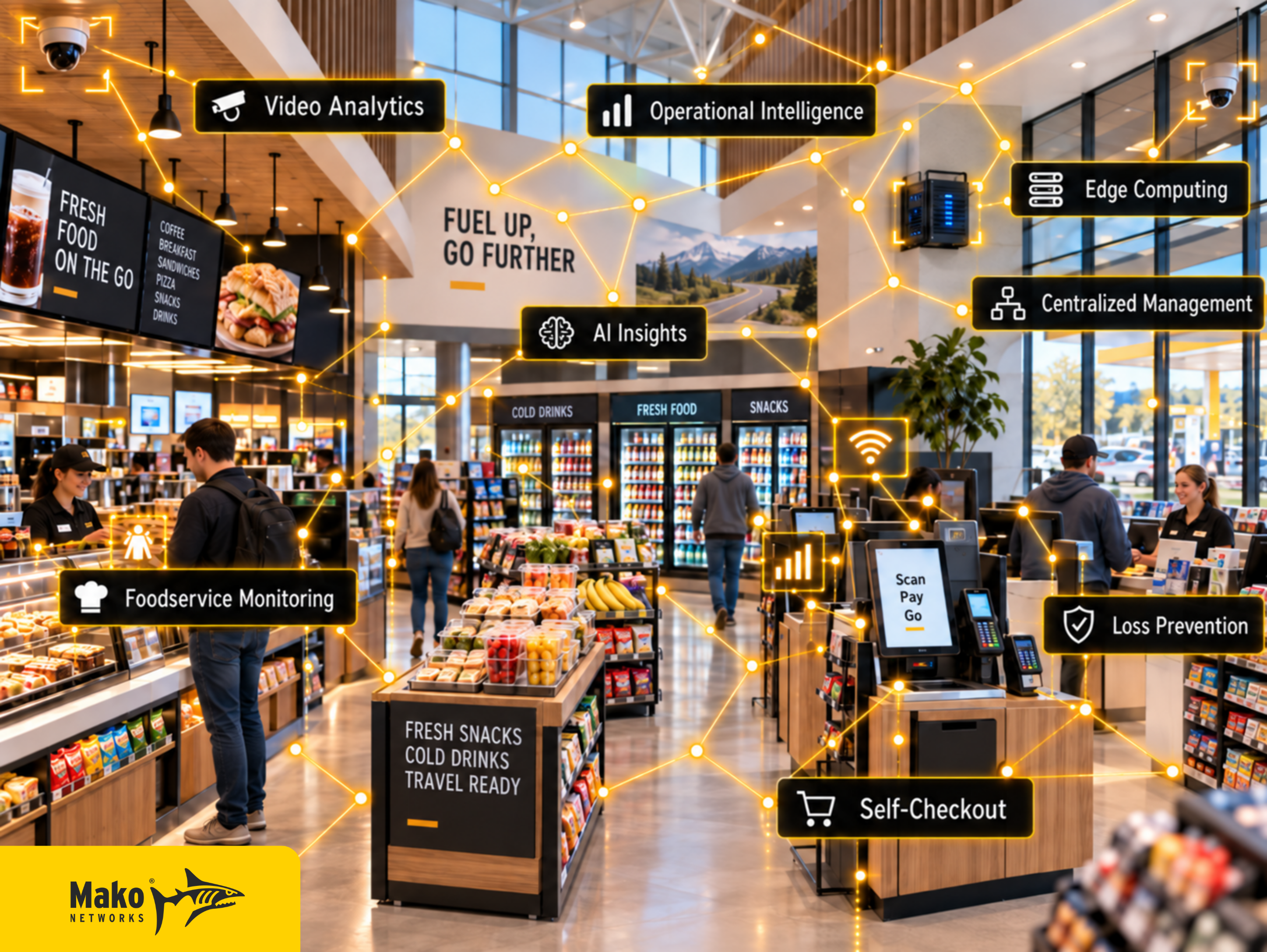
Applications such as video analytics, loss prevention, foodservice monitoring, workforce optimization and operational intelligence are enabling retailers to automate processes and uncover new insights. But while much of the discussion focuses on the AI applications themselves, less attention is given to the infrastructure required to support them.
"The industry is focused on what AI can do," said Jon Kelly, chief revenue officer at Mako Networks. "The bigger question is whether retailers have the technology foundation necessary to deploy and scale it."
Many emerging retail applications generate large amounts of data that must be processed, secured and acted upon in near real time. Sending every piece of information to the cloud can create delays, increase costs and add complexity.
As a result, retailers are increasingly looking at edge computing, which allows applications and data processing to occur closer to where information is created.
"The industry is moving toward platforms capable of hosting applications directly at the edge," Kelly said. "That creates opportunities to deploy new technology faster and make stores more responsive to changing business needs."
This shift is becoming increasingly important as retailers seek to simplify their technology environments.
Many stores still operate with separate routers, firewalls, VPN appliances, security products and cellular backup devices. Each system introduces additional costs, management requirements and potential points of failure.
According to Kelly, the next generation of retail infrastructure consolidates these functions into a centrally managed platform that reduces complexity while creating a stronger foundation for growth.
"The most successful retailers are standardizing on platforms rather than managing collections of products," he said.
That approach helps retailers deploy innovations more quickly while maintaining consistency across multiple locations.
Platforms such as the Mako 6700 are helping accelerate that transition by combining enterprise security, managed connectivity, edge application support and centralized management into a single architecture.
"The future isn't about adding more technology," Kelly said. "It's about creating a foundation that allows new technology to be adopted quickly, securely and consistently."
As AI, automation and connected-store initiatives continue to reshape convenience retail, the retailers best positioned for success may not be the ones with the most applications. They may be the ones with the strongest platform underneath them.
"The question is no longer whether retailers need a better network," Kelly said. "The question is whether they have a platform capable of supporting the next decade of innovation."
This article is the second in a two-part series from Mako Networks. Read part one to learn why retailers are rethinking the role of the network in store operations.
Artificial Intelligence Data management
